
How to Search Criminal Dockets
Begin with whatever paper started the case. The charging document, a court notice, or an old order will name the court. That name should drive your Jefferson Parish criminal docket search. Have a 24th Judicial District Court case? The Jefferson Parish Clerk of Court offers JeffNet service as the local access point. Search by case number first. That is the surest way to separate one case from a pile of similar names. Search by name only when you must. Keep the spelling tight. Then confirm the parish, filed date, and charge description before trusting the result.
No court named on the paper? Turn to eClerks LA Criminal Search, a statewide index. Work backward from there to the Jefferson Parish court that actually holds the record. A hit there might point to a parish court or even another parish. It cannot convert a city ordinance matter into a 24th JDC case. And it never replaces the clerk's current docket as the authority.
- Identify the issuing court or use the case number when one is known.
- Open JeffNet for a 24th JDC or parish-court matter, or narrow eClerks LA by Jefferson Parish and a date range.
- Match the case, filing date, parish, and charge before opening the record detail.
- Read the activity or minute details for settings, filings, and any recorded disposition.
- Use the responsible clerk when a document, a current confirmation, or a copy is needed.
Jefferson Parish JeffNet Criminal Activity
How far back does JeffNet go for Jefferson Parish? The service describes its coverage as 24th JDC criminal case activity from April 28, 1994 forward. It also covers parish criminal and traffic activity from 1990 forward. Treat those as service ranges. They are not a guarantee that every file, image, or restricted record will surface online. Images depend on record status. You may see an activity line while the underlying document stays out of reach through the same route. The Clerk's generic criminal e-filing screen shows the electronic filing environment that works with the local record system.
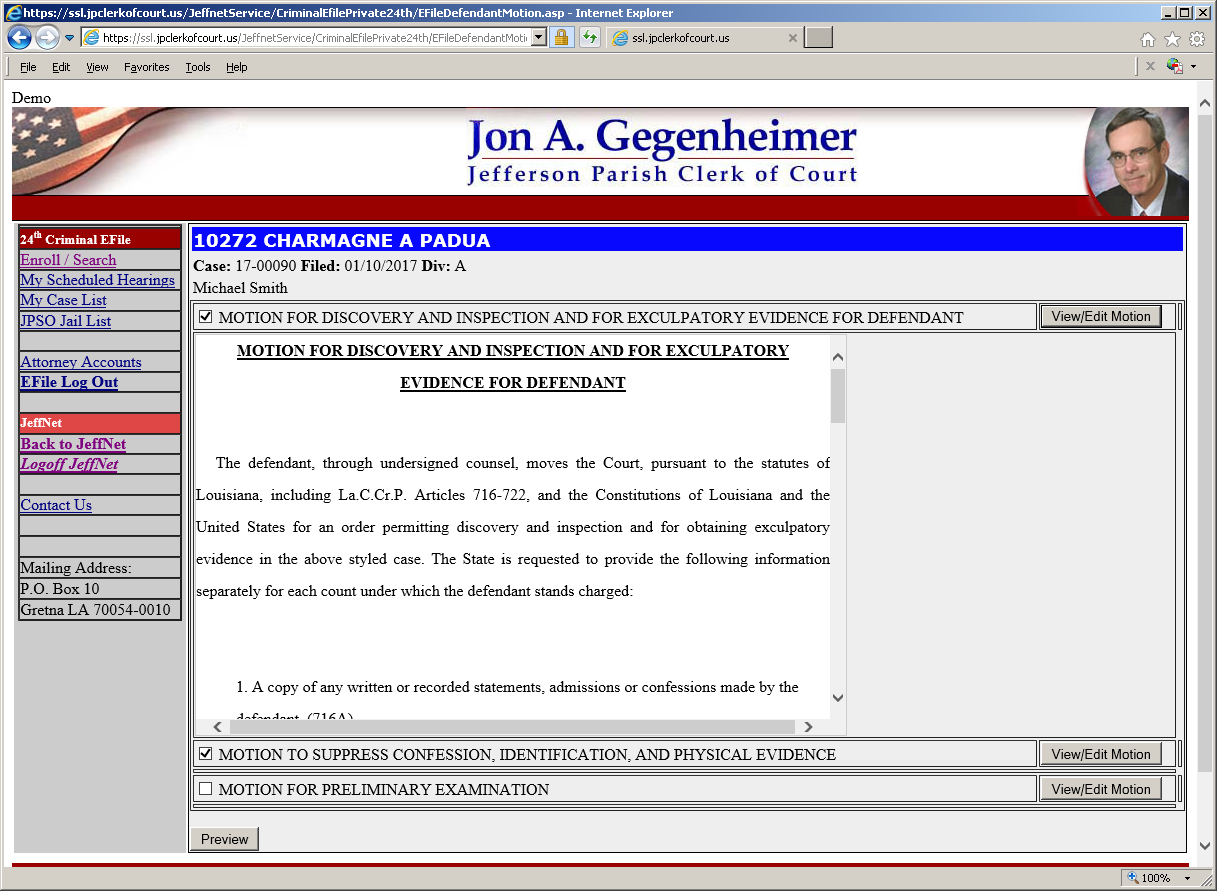
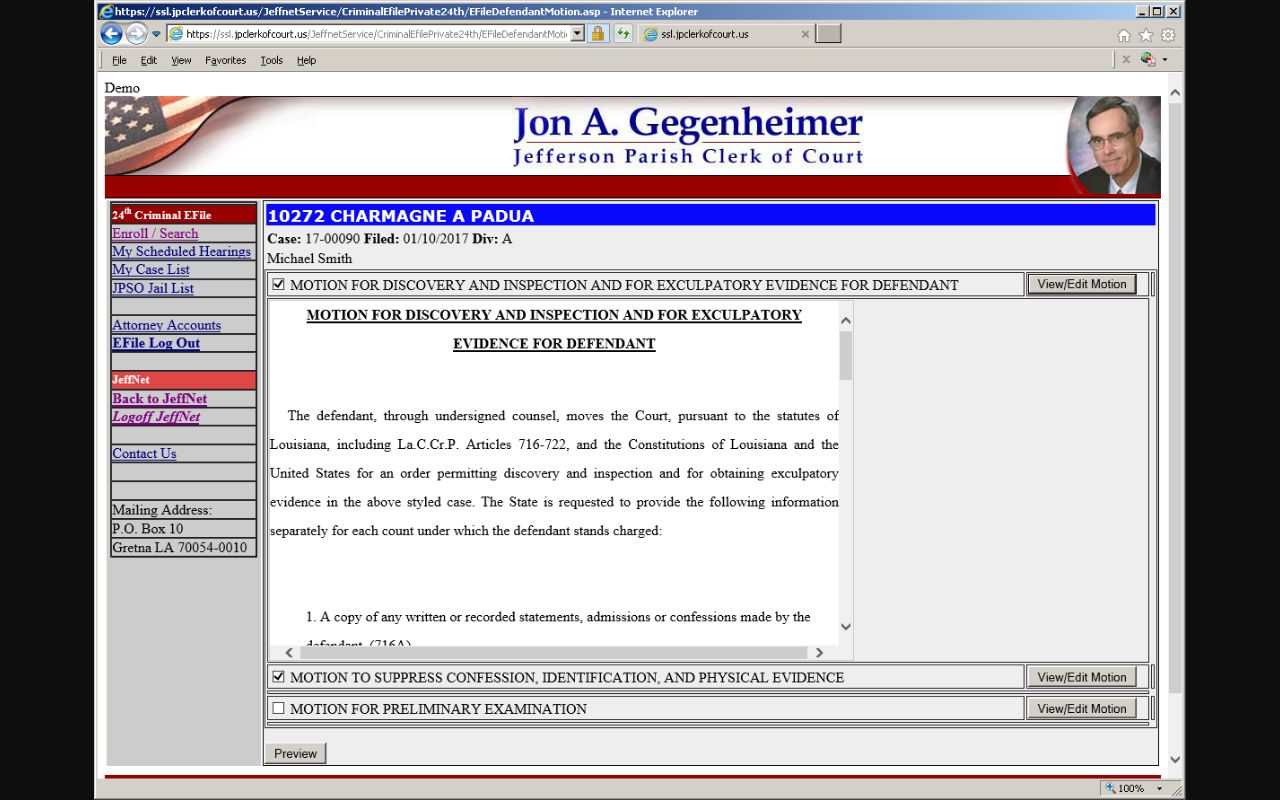
One screen, two questions. Filing electronically is one thing. Viewing public records is another, and the docket still has to answer for the court, the status, and any access restriction. JeffNet sells both short-term and subscriber access, with separate charges for some images and certified records. Skip the guesswork. The Clerk fee schedule tells you the current copy method and charge.
Jefferson Parish eClerks Criminal Search
The official eClerks Criminal Search guide lays out the statewide search fields: last name, first name, from date, to date, and parish checkboxes. Results can return a case. You get its filed date, charges, parish, and alert information. Open the detail view for more. There you may find the parish contact and minute details. Those fields are how you sort multiple Jefferson Parish matches. Do not lean on a name alone.
| Search field | How it helps |
|---|---|
| Last and first name | Starts the statewide search, but may return similar names. |
| Date range | Reduces older or unrelated Jefferson Parish results. |
| Parish | Confirms whether the result belongs in Jefferson Parish. |
| Case and date filed | Helps separate records that share a name or charge description. |
One caution. An eClerks result points you toward the responsible clerk record; it is no substitute for checking the current Jefferson Parish docket itself.
What a Criminal Docket Shows
What does a Jefferson Parish criminal docket actually contain? It is a chronological record of case activity, not a narrative of every fact. Expect a case number and a filed date. Charge descriptions, courtroom activity, a scheduled arraignment, a filing the clerk received, or a later disposition label round out the page. A minute entry is simply a dated notation. The court or clerk makes it. It records an event without reproducing the full pleading, order, or transcript behind it.
| Case number | The identifier shown in the local or statewide case detail. |
|---|---|
| Charges | The charge description in a result, which is not itself a finding of guilt. |
| Minute details | Dated entries such as a filing received or an arraignment setting. |
| Hearing setting | A scheduled event that can change before the hearing occurs. |
| Disposition | A status that needs the exact official label and current context. |
Read labels with care. A charge, an arrest date, and a docket event are not the same thing as a conviction. When you need the full text of a filing or order, ask whether a document image, a clerk copy, or another records route exists.
Jefferson Parish Minute Detail Terms
Minute-detail language runs short on purpose. Read the actual Jefferson Parish label. Do not stretch it into a conclusion the record never states. The eClerks guide offers examples of routine procedural entries: a filing received, a motion and order to enroll counsel, a district attorney acceptance notation, and an arraignment set for a later date.
- Received
- The clerk recorded receipt of a filing. It does not say that a judge has ruled on it.
- Set
- A hearing or event was placed on a calendar and may later be continued or changed.
- Minute entry
- A dated event notation, not necessarily a complete document image.
- Disposed
- A case-status word that needs the full official context before it is read as a particular outcome.
The generic criminal case interface shows the structured display style used for criminal record activity in Jefferson Parish.
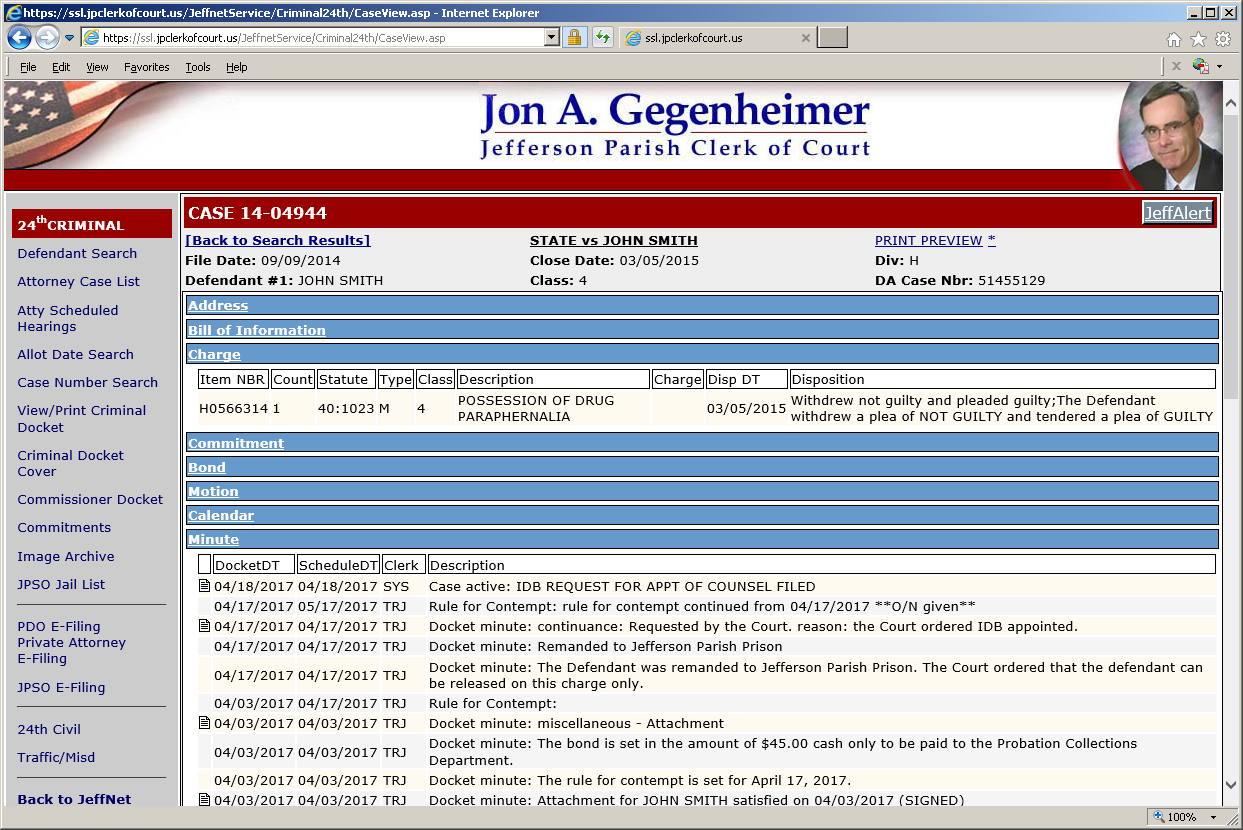
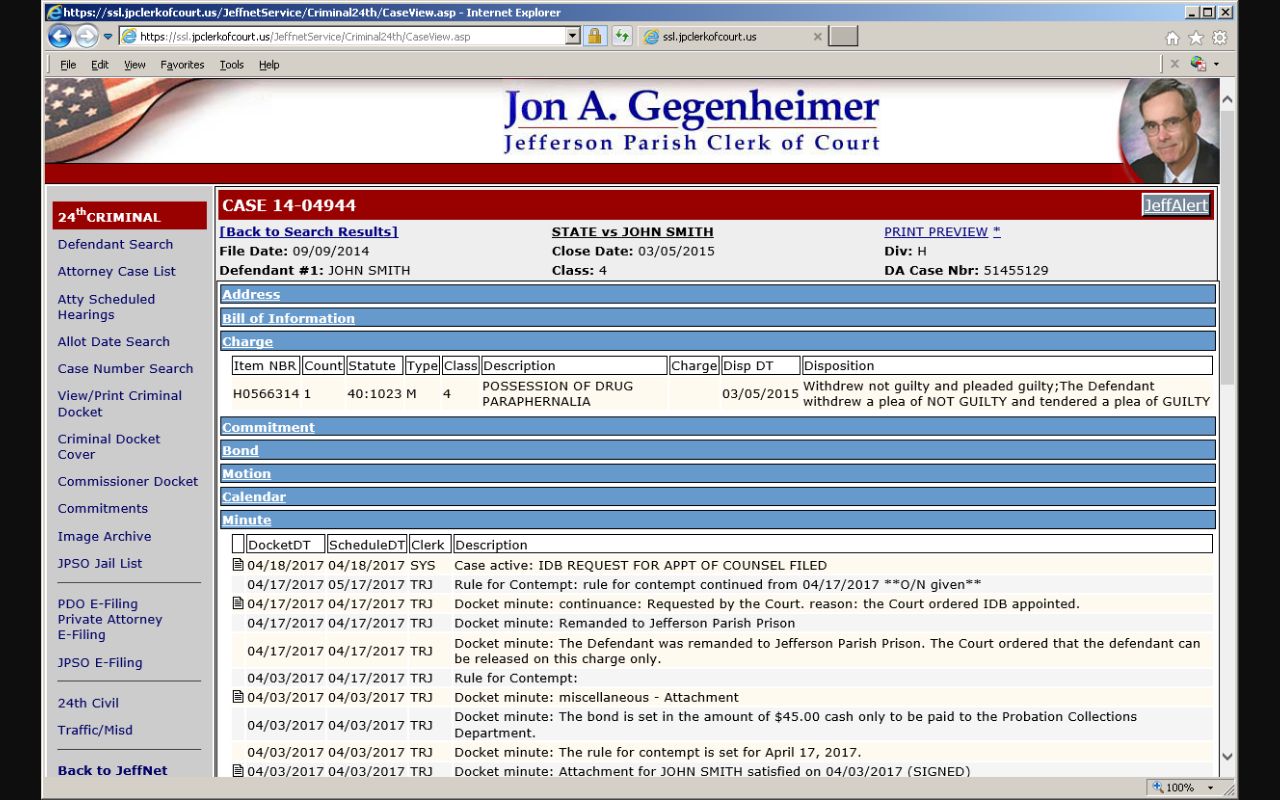
Treat interface labels as a map. Then confirm any meaningful status with the Jefferson Parish clerk or the court that entered it.
Stages on a Criminal Docket
A Jefferson Parish criminal case usually marches from charge or filing to arraignment, pretrial settings, a plea or trial event, and a recorded disposition. At any moment the docket may show only part of that sequence. An arraignment date is a calendar event. A received motion is a filing event. Neither one tells you the result of the case.
Docket flow: Charge Filed › Arraignment › Pretrial Settings › Plea or Trial › Disposition › Sentencing
Need a transcript? Use the court's separate transcript request route. A minute entry and a court reporter transcript are different record products, and Jefferson Parish treats them that way.
Jefferson Parish Criminal Records Suite
Criminal Records Suite 1100 is the in-person option for 24th JDC criminal files. Think of it as the walk-in counterpart to the online portal. The Clerk's 24th JDC records page lays out the public workstations and what the records staff can pull. It is worth a look before any trip. A visit makes sense when JeffNet lacks a document image. It also helps when a Jefferson Parish docket result needs a second check on paper.
Come prepared. A case number speeds everything up. Without one, give staff the name, the court, a rough date, and the type of record you need. With those details, they can tell you where the file sits. It might sit with the clerk or the court. It could be under seal, expunged, or in the juvenile division. Or it may sit with another Jefferson Parish court entirely.
Jefferson Parish Court Routing
Jefferson Parish criminal cases do not land in one docket. The 24th JDC handles the serious felony work as the general-jurisdiction trial court. Parish-court matters split geographically. First Parish Court covers the East Bank. Second Parish Court takes the West Bank plus Grand Isle. City ordinance and municipal cases stay with the local Mayor's and Municipal Courts. Whatever court is printed on your notice is where your first call belongs.
| Possible court | Practical record route |
|---|---|
| 24th JDC | JeffNet or Criminal Records Suite 1100. |
| First Parish Court | East Bank criminal records, (504) 736-8910. |
| Second Parish Court | West Bank courthouse administrative or criminal route. |
| Municipal or Mayor's Court | The city clerk or court named on the local matter. |
Note: A Jefferson Parish city case does not land in the 24th JDC criminal docket by default.
Which Court Holds Criminal Dockets
Treat the Jefferson Parish court system as a routing map, not a single merged database. The 24th JDC keeps its own district-court criminal dockets. The parish courts handle limited matters, misdemeanors and traffic among them, within their stated roles. A Kenner case, or one from another city, may sit with that municipal clerk instead. The Jefferson Parish Clerk serves the main parish courts. Yet a city record stays a local court record no matter what.
Federal charges live somewhere else entirely. Those cases run through PACER and CM/ECF for the Eastern District of Louisiana. They do not run through JeffNet or eClerks LA. A federal case number, a federal notice, or a federal courthouse caption means you need that system. You do not need a Jefferson Parish criminal docket search.
Jefferson Parish Criminal Request Options
An online docket search does not always get you the whole file. When it stops short, Jefferson Parish gives you other moves. Visit the clerk's records desk. Use a public workstation for the right court. Call the parish court that holds the record, or send a written public-record request that spells out what you want. A solid request names the court and the case number or party name. Add the date range and the record type. Say whether you want to inspect or get copies. Court-custody and clerk-custody requests go to different recipients under the 24th JDC public-record process. Match the request to the holder.
Routing still applies offline. A municipal ordinance matter belongs with the municipal clerk. A federal matter belongs with PACER. The Jefferson Parish request works best when it follows custody rather than a vague search label.
Public Access and Sealed Criminal Dockets
Louisiana's access rules do not throw every Jefferson Parish criminal item open to the public. Several things decide the answer. Who holds the record, which court it belongs to, and the record type all matter. Seal status matters. The confidentiality law that applies matters too. During regular office hours you may inspect or request an eligible clerk-held record. But a protected identifier, a sealed filing, a juvenile file, or an expunged entry plays by different rules. Ask the court for its access procedure. Do not assume that anything missing online was never filed at all.
A focused Jefferson Parish request should name the court, the case number or name, and the date range. Say what you want, whether that is the docket, an image, a copy, or a look at the file. The custodian can then explain what is available. It can say what carries a charge, what is restricted, and what belongs to another office.
Key Rules:
Louisiana Code of Civil Procedure Article 251 permits inspection and copying of clerk records unless another law provides otherwise.
R.S. 44:31 recognizes a public-access right while placing the burden of an exemption on the custodian.
R.S. 44:32 addresses office-hour inspection, copying, and related procedures.
Jefferson Parish Juvenile Record Limits
Juvenile Court records mark the clearest limit on any Jefferson Parish criminal docket search. The Clerk says so plainly. They are not open to public examination. They never appear on JeffNet. Children's Code Article 412 keeps juvenile records and proceedings confidential except in defined situations. A narrow recent state provision covers certain violent-crime minute entries. It does not turn juvenile files into ordinary public criminal dockets. For anything juvenile, use the authorized Juvenile Court or clerk route. Never guess at access from a general criminal search result.
Jefferson Parish Expunged Docket Records
Expungement draws another hard line. Under CCrP Article 972, expungement pulls a record out of public view. It does not destroy the underlying files. Article 973 then keeps those records confidential while allowing a few statutory exceptions. The Clerk's forms page posts the current expungement packets. It promises no eligibility and no result. A Jefferson Parish docket search that once turned up a case cannot beat an expungement rule. It cannot beat a sealing rule either. Confirm the current status with the clerk or court in charge of the record.